Saturday, August 15, 2020

Ora pro nobis

“Any concern too small to be turned into a prayer is too small to be made into a burden.”

—Corrie Ten Boom


By Alex P. Vidal


INSTEAD of donating wheelchairs, we suggest to our Filipino-Chinese donors and other Good Samaritans in Iloilo to donate face masks and hand sanitizers.

Wheelchairs are good, but what the Ilonggos need right now are more face masks and hand sanitizers because we are up against a treacherous virus that threatens to kill a million or more human beings this year.

Already reeling from economic meltdown as a result of pandemic-induced extended lockdowns and recession, many Ilonggos can’t afford to sustain the stocking of face masks for a day-to-day use.

Tight in budget, they would rather use their limited funds to buy food and pay their bills. 

Face masks have become an annoying burden in their household budget. 

Since the pandemic is still very much active and destructive, health authorities will continue to mandate that Ilonggos should wear masks and other protective gears like face shields in order to prevent the hike of coronavirus disease 2019 (COVID-19) cases and deaths.

Also, with due respect to the donors, donate “silently” and refrain from unnecessary publicity, if possible. 

God will appreciate our charitable act more if we don’t let our left hand know when our right hand is helping someone.


-o0o-


DO the Ilonggos still receive free hot pandesal now that the pandemic has extended?

Now the Iloilo City will be under general community quarantine (GCQ) together with three Luzon provinces and parts of Cebu until the end of August, will the corporations that launched the free pandesal make another round of distributions to the public?

On April 7, 2020, thousands of “Ilonggo Pandesal” were distributed by private corporations to the Iloilo City indigent families as requested by Mayor Geronimo “Jerry” P. Treñas.

It was reported that more than 40,000 pieces of the locally made pandesals were given on a house-to-house routine directly to the poor families in the city’s 180 villages during the lockdown on collaboration by the La Filipina Uygongco, Great Harvest Commodities, Carlos Uy Corporation and Angelina Bakeshop.

Treñas said the usual production was 43,200 pieces or 5,400 packs even as the bakers targeted to produce 43,200 packs equivalent to 648,000 pieces in 15 days. 

Each pack reportedly contained eight pieces of pandesal and the bakers produced approximately 62,500 pieces or 7,800 packs per day.

“Pandesal may just be a common bread. But for the Ilonggos, it is a symbol of generosity and unity in times of crisis in the City of Love,” declared the Iloilo City Government in a Facebook post dated April 12, 2020.

This generous gesture by by the bakers and the corporations that pooled their resources was laudable and impressive. In one way or the other, the free pandesalbecame a symbol of Ilonggo unity and benevolence from these corporations that did not abandon the Ilonggos during the lockdown.


-o0o-


ORA pro nobis. Scientists have been scrambling to produce the vaccine against COVID-19 and the efforts made by many countries have become political, or actually a race to be the first to produce the vaccine.

Thus the Sputnik V of Russia got mixed reactions from health authorities mostly in Western countries that doubted the Russian-made vaccine’s safety and effectivity.

Concocting a vaccine is not the same thing as proving a vaccine is safe and effective, according to Dr. Anthony Fauci, the director of the U.S. National Institute of Allergy and Infectious Diseases, who made the comments as part of a keynote interview for Stopping Pandemics, an exclusive event due to air August 13 via National Geographic. 

While scientists dispute, did some people think of turning spiritual or praying that the “real” or “most effective” vaccine be discovered soon, something that all medical experts and authorities will finally agree? 

Why not also start praying seriously for the pandemic to disappear soon while the world is waiting for the magic vaccine? There’s no harm in trying. After all, genuine prayers and research can be potent combinations.

We pray to you, Lord.

(The author, who is now based in New York City, used to be the editor of two local dailies in Iloilo)


Friday, August 14, 2020

Warning: Don’t let anyone get too close

“If you have a secret, people will sit a little bit closer." 

—ROB CORDDRY 

By Alex P. Vidal

TRUST remains to be the most important aspect of any meaningful relationship.

"More specifically, it is a mutual condition that must exist between a manager and his subordinates, a husband and wife, and between friends," wrote Dr. Jan Halper, author of Quite Desperation.

Halper warned that a husband who doesn't trust his wife to listen and be supportive will not disclose his personal thoughts and feelings. If he doesn't trust her judgment, he will not confide in her. 

"As a result, they will grow apart. A manager who doesn't trust his subordination will not delegate responsibility or authority. Instead he will resort to controlling them," Halper stressed. 

"When employees don't feel trusted they are likely to become territorial, derisive, and antagonistically competitive."

SEARCH

In his book Man's Search for Himself, Rollo May discussed the destructive aspects of this attitude:

--this type of individual competitiveness--in which for you to fail in a deal is as good as for me to succeed, since it pushes me ahead in the scramble up the ladder--raises many psychological problems. It makes every man interpersonal hostility and resentment, and increases greatly our anxiety and isolation from each other.

Raised with a competitive spirit, where winning is more important than caring, competition more important than friendship, men search for their opponents' vulnerable points to be used as ammunition in the future, explained Halper.

Halper cited the case of investment banker Anthony Rich, who told him, "I store confidences away to be used at a later date, if it's to my advantage. Any bit of knowledge is fair game to be used against your perceived enemy in order to declare a victory." Although Rich did not admit it, Halper said the implication was there: "It's okay to betray someone you treat as a friend if it means winning or losing."

COMPETITIVENESS

Consequently, this intense competitiveness and desire to win breed fear and distrust between men, according to Halper.

Halper said in general, men are discouraged from "opening their kimono" with one another. They are told to never count on anyone but themselves. Halper found that when he encouraged men to talk with one another about their haunting conflicts and issues, that which was troubling them suddenly seemed less important or disappeared.

"They unburdened themselves of feeling vulnerable by exposing their private side and finding someone who understood them," he pointed out. "Most often the men I interviewed were shocked at how a simple step could alleviate their loneliness and pain and provide clarity and insight."

Although there is some truth to the assertion that men distrust others because they themselves can't be trusted, another important factor comes into play, Harped said. 

CONTROL

"Men don't believe they are in control of their feelings, that they choose to feel as they do. Instead they think feelings are something that come over them, that they are made to feel as they do by a mysterious external force," explained Halper. "They attribute the power and ability to others, believing someone else made them feel fear, hurt, happiness, or anger."

Men fear getting close to anyone, women or men, because it's another way they might put themselves on the line, becoming vulnerable, asserted Halper.

"Countless men told me they longed to be close to others, but if it meant feeling out of control, they didn't want anything to do with intimacy," he noted.

Thursday, August 13, 2020

Spiritual healing in a science of thought

“The mind when it has an old experience will add that data into its current experience, and it keeps coming up with wrong answers.”

—L. Ron Hubbard


By Alex P. Vidal


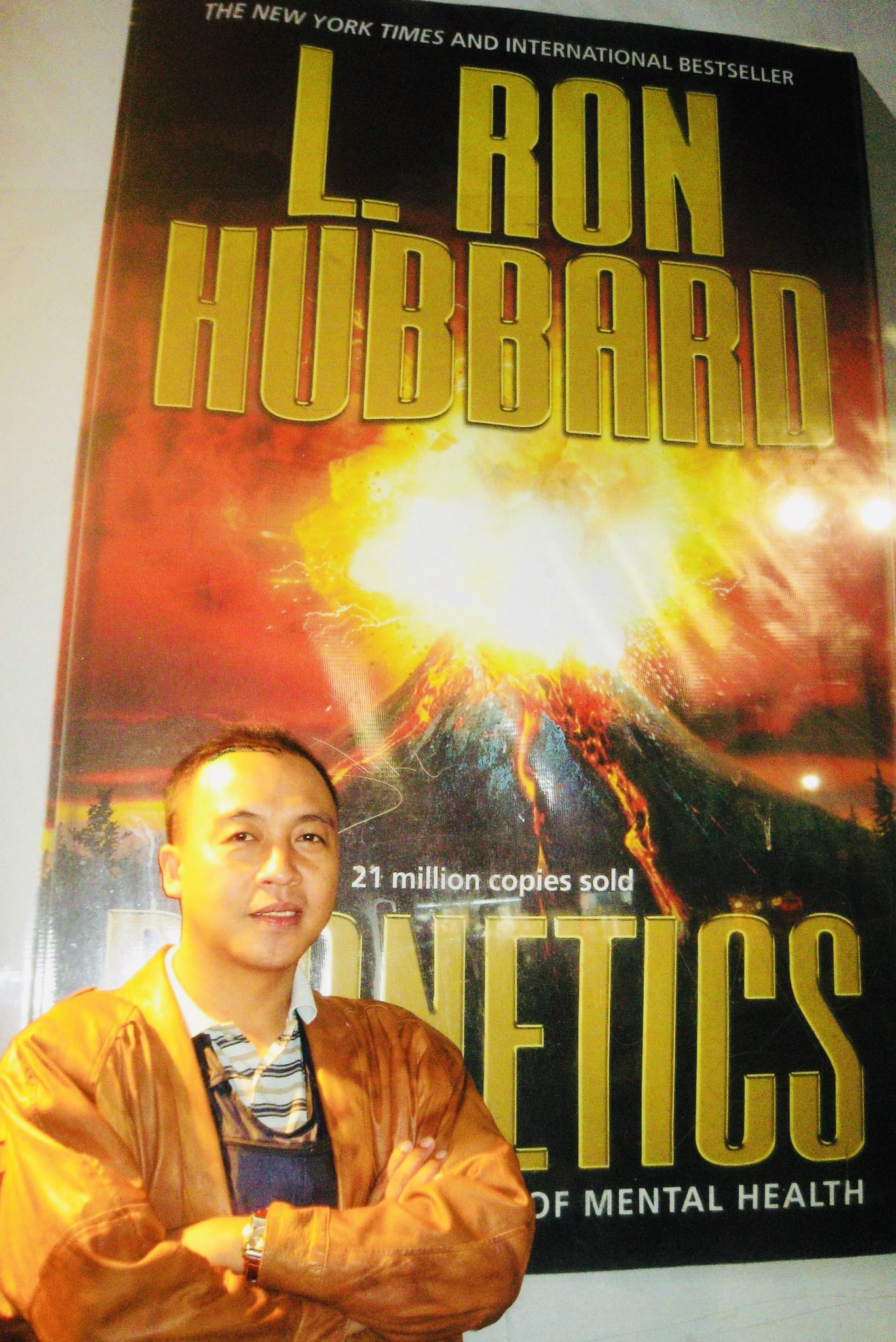
ONE of the most accessible and popular books that we always see when we go to the bookstores in the Philippines and abroad is L. Ron Hubbard's Dianetics. 

This book competes with the Holy Bible and the Webster's Dictionary in terms of visibility and probably number of copies sold and displayed in the bookstores worldwide.

In book sales, Dianetics has been dominant and affordable; sometimes it could cost an incredible P20! 

Our late friend, philosopher-lawyer Ernesto Justiniani Dayot, got a copy—an "anniversary issue"—for only P12 in a book sale in Atrium Mall in Iloilo City on September 28, 2011.

A brand new anniversary issue copy was priced at P375.

Dianetics is a set of ideas and practices regarding the metaphysical relationship between the mind and body invented by the science fiction author and is practiced by followers of Scientology. 

Hubbard coined Dianetics from the Greek stems dia, meaning through, and nous, meaning mind.

Dianetics explores the existence of a mind with three parts: the conscious "analytical mind," the subconscious "reactive mind", and the somatic mind. 

The goal of Dianetics is to remove the "reactive mind", which Scientologists believe prevents people from becoming more ethical, more aware, happier and saner. 

The Dianetics procedure to achieve this is called "auditing". Auditing is a process whereby a series of questions are asked by the Scientology auditor, in an attempt to rid the auditee of the painful experiences of the past which scientologists believe to be the cause of the "reactive mind".


-o0o-


According to Wikipedia, Dianetics grew out of Hubbard's personal experiences and experiments and has been described as a mix of "Western technology and Oriental philosophy".

Hubbard stated that Dianetics "forms a bridge between" cybernetics and General Semantics, a set of ideas about education originated by Alfred Korzybski that was receiving much attention in the science fiction world in the 1940s. 

Hubbard claimed that Dianetics can increase intelligence, eliminate unwanted emotions and alleviate a wide range of illnesses he believed to be psychosomatic. 

Among the conditions purportedly treated against are arthritis, allergies, asthma, some coronary difficulties, eye trouble, ulcers, migraine headaches, sex deviations and even death. Hubbard variously defined Dianetics as "a spiritual healing technology" and "an organized science of thought."

Dianetics predates Hubbard's classification of Scientology as "applied religious philosophy". 

Early in 1951, he expanded his writings to include teachings related to the soul, or "thetan".

Dianetics is also practiced by independent groups, collectively called the Free Zone. The Church of Scientology disapproves of Free Zone activities and has prosecuted them in court for misappropriation of Scientology/Dianetics copyrights and trademarks.


-o0o-


Hubbard always claimed that his ideas of Dianetics originated in the 1920s and 1930s. By his own account, he spent a great deal of time in the Oak Knoll Naval Hospital's library, where he would have encountered the work of Freud and other psychoanalysts. 

In April 1950, Hubbard and several others established the Hubbard Dianetic Research Foundation in Elizabeth, New Jersey to coordinate work related for the forthcoming publication. 

Hubbard first introduced Dianetics to the public in the article Dianetics: The Evolution of a Science published in the May 1950 issue of the magazine Astounding Science Fiction. Hubbard wrote Dianetics: The Modern Science of Mental Health at that time, allegedly completing the 180,000-word book in six weeks.

The success of selling Dianetics: The Modern Science of Mental Health brought in a flood of money, which Hubbard used to establish Dianetics foundations in six major American cities. 

The scientific and medical communities were far less enthusiastic about Dianetics, viewing it with bemusement, concern, or outright derision. Complaints were made against local Dianetics practitioners for allegedly practicing medicine without a license. This eventually prompted Dianetics advocates to disclaim any medicinal benefits in order to avoid regulation.

Hubbard explained the backlash as a response from various entities trying to co-opt Dianetics for their own use. Hubbard blamed the hostile press coverage in particular on a plot by the American Communist Party. In later years, Hubbard decided that the psychiatric profession was the origin of all of the criticism of Dianetics, as he believed it secretly controlled most of the world's governments.


-o0o-


By the autumn of 1950, financial problems had developed, and by November 1950, the six Foundations had spent around one million dollars and were more than $200,000 in debt. 

Disagreements emerged over the direction of the Dianetic Foundation's work, and relations between the board members became strained, with several leaving, even to support causes critical of Dianetics. One example was Harvey Jackins, founder of Re-evaluation Counselling, originally a sort of discrete reworking of Dianetics, which L Ron Hubbard later declared suppressive to Scientology.

In January 1951, the New Jersey Board of Medical Examiners instituted proceedings against the Hubbard Dianetic Research Foundation in Elizabeth for teaching medicine without a licence. The Foundation closed its doors, causing the proceedings to be vacated, but its creditors began to demand settlement of its outstanding debts. Don Purcell, a millionaire Dianeticist from Wichita, Kansas, offered a brief respite from bankruptcy, but the Foundation's finances failed again in 1952.

Because of a sale of assets resulting from the bankruptcy, Hubbard no longer owned the rights to the name "Dianetics", but its philosophical framework still provided the seed for Scientology to grow. Scientologists refer to the book Dianetics: The Modern Science of Mental Health as "Book One." In 1952, Hubbard published a new set of teachings as "Scientology, a religious philosophy." Scientology did not replace Dianetics but extended it to cover new areas. Where the goal of Dianetics is to rid the individual of his reactive mind engrams, the stated goal of Scientology is to rehabilitate the individual's spiritual nature so that he may reach his full potential.


-o0o-


In 1978, Hubbard released New Era Dianetics (NED), a revised version supposed to produce better results in a shorter period of time. The course consists of 11 rundowns and requires a specifically trained auditor. It is run (processed) exactly like Standard Dianetics (once very widely practiced before the advent of NED) except the pre-clear (parishioner) is encouraged to find the "postulate" he made before the incident occurred. ("Postulate" in Dianetics and Scientology has the meaning of "a conclusion, decision or resolution made by the individual himself; to conclude, decide or resolve a problem or to set a pattern for the future or to nullify a pattern of the past" in contrast to its conventional meanings.)

New Era Dianetics is really only a prelude to what is available at the high levels of the Bridge including the incidents: New Era Dianetics for OTs also known as NOTS. It is available after Xenu and the now well known First Wall of Fire. NOTS is also known as the Second Wall of Fire. Free Zone (Scientology) offers a version of it in the Internet

The procedure of Dianetics therapy (known as auditing) is a two-person activity. One person, the "auditor", guides the other person, the "preclear". 

The preclear's job is to look at the mind and talk to the auditor. The auditor acknowledges what the preclear says and controls the process so the preclear may put his full attention on his work.

(The author, who is now based in New York City, used to be the editor of two local dailies in Iloilo)


Wednesday, August 12, 2020

Newspaper offices go extinct

“Given how few young people actually read the newspaper, it's a good thing they'll be reading a newspaper on a screen.”

—Bill Gates


By Alex P. Vidal


IT’S hard to imagine the Philippine newspapers—national and regional—operating without a newsroom.

In the News Express, the first regional newspaper I had the privilege to work with in March 1988, a tiny room usually reserved for dentists in the second floor of the Saint Elizabeth Building on Valeria Street in Iloilo City, had served as our first “newsroom.” 

Except for the two old typewriters, bond papers, and other office supplies, there was nothing tantalizing from the naked eye to be found in that modest newsroom except that it symbolized the newspaper’s heart and soul.

When publication technology was still in infant stage, the newspaper and the newsroom were like siamese twins—inseparable.

It’s in the newsroom where reporters rush from the field and spend time beating the deadline, drafting stories to be modified and sanitized by editors.

No decent newspaper can roll off the press without first undergoing a major critiquing and fine-tuning from the editorial think tank inside the newsroom.

A newsroom is to the newspaper, TV network, and radio station what the altar is to the chapel.   

It’s the reporters’ and editors’ sacred territory and no politician, or any news subject for that matter, can easily gain access to unless he is a controversial public figure invited as a guest in an off-work bull session with members of the editorial board usually during the candidate’s hour in the election season.


-o0o-


Lately, as reporters learned to work remotely owing to the pandemic-motivated lockdown and social distancing, major newspapers have adopted belt-tightening schemes as a matter of economic survival.

This has happened—or is happening—, believe it or not, to one of the world’s leading newspapers based in New York City.

And it can certainly happen to the newspapers in the Third World, especially if the pandemic will prolong and the global economy will collapse as a result.

The New York Daily News, officially titled the Daily News, an American newspaper based in New York City and founded in 1919 as an imitation of the British Daily Mirror, is about to become a newspaper without a newsroom. 

Daily News was the first U.S. daily printed in tabloid format and it reached its peak circulation in 1947, at 2.4 million copies a day.

Tribune Publishing, which has owned the 101-year-old tabloid since 2017, confirmed on August 12 that it will shutter the paper’s newsroom in downtown Manhattan permanently later this year and has no plans to return.


-o0o-


The New York Post reported that the company insisted it will keep a print edition of the paper alive, noting that its reporters and editors have been working remotely since the pandemic started in March. 

They will reportedly be given until Oct. 30 to collect their belongings from the office.

“Out of an abundance of caution we do not anticipate having employees that can work remotely coming back into the office for the remainder of the year and into 2021,” a Tribune spokesman said quoted by the New York Post.

“With no clear path forward in terms of returning to work, and as the company evaluates its real estate needs in light of health and economic conditions brought about by the pandemic, we have made the difficult decision to permanently close the office.”

The spokesman added, quoted by the New York Post, that “today’s announcement relates only to the closure of the physical office at 4 New York Plaza. We are not ending print editions.”


-o0o-


The company also reportedly said it is shutting down its offices for the Capitol Gazette in Annapolis, Md.; the Carol County Times; and the Florida office that houses the Orlando Sentinel.

The paper’s most famous newsroom was at 220 E. 42nd St. which is still known as the Daily News Building, even though it had not housed the paper since the late 1990s.

The building, especially its exterior, was used as a stand-in for the fictional Daily Planet in the first “Superman” movie starring Christopher Reeve in 1978. 

Its then moved to a building at 450 W. 33rd on the far West Side, which had only one nearby bar called Farrell’s.

In another cost-cutting move, then-owner Mort Zuckerman moved the paper to its current location in 2010.

(The author, who is now based in New York City, used to be the editor of two local dailies in Iloilo)


Tuesday, August 11, 2020

Four scary months

“I'm very pro vaccine. I get all six of my kids vaccinated. I believe vaccines save millions of lives, and people ought to be getting vaccinated.”

—Robert Kennedy, Jr.


By Alex P. Vidal 


LET us not be confused. 

Let’s be informed and remain vigilant. 

Authorities should refrain from giving us false hopes now that China is reportedly a cinch away from developing a vaccine and, recently, Russia joined the fray with their much-ballyhooed “Sputnik-V” vaccine.   

We can’t be “back to normal” by December 2020 as what President Rodrigo R. Duterte had promised “by the grace of God” in as far as our suffering from the novel coronavirus disease (COVID-19) is concerned.

“My plea is to endure (restrictions) some more. Many have been infected,” Duterte said during a pre-recorded address aired on August 7. “If you can endure until December … China is first (in the vaccine race).

“I promise you by the grace of God I hope by December we will be back to normal … let’s just wait for the vaccine. It’s almost here. I told you I have been praying to God for a guiding light so that these guys can make the vaccine.”

If he was referring to the vaccine China had “first” approved, there’s no assurance it will be available and ready to save mankind from the deadly virus that has killed nearly 800,000 people worldwide four months from now.

On the other hand, the next four months of our lives in the remaining sunlights of 2020 will be scarier with or without the vaccine from China.


-o0o-


Assuming that the China vaccine will get the approval of the World Health Organization (WHO) or will pass the Phase III trials, December 2020 won’t be the most likely magic month.

Assuming also that Sputnik-V will also get the same status, it may not be available within four months from now or in December 2020.

No less than Russian President Vladimir Putin has said the vaccine, developed by Russia's Gamaleya Research Institute of Epidemiology and Microbiology and based on other coronaviruses that cause harmless colds that has been tested on several dozen people, including military personnel and researchers themselves, would be available to the general public on Jan. 1, 2021.

Russia is among the countries hit hardest by the pandemic, with nearly 900,000 confirmed coronavirus cases and more than 15,000 COVID-19 deaths, as of August 11, according to a tally kept by Johns Hopkins University. 

Although the official number of cases has steadily declined in recent weeks, the country still has the fourth highest number of cases.

Putin is eager to show progress in fighting COVID-19, which he initially downplayed, and even the name of the vaccine, which hearkens back to Soviet Russia's first artificial satellite in 1957, is reminiscent of a Cold War-era scientific triumph.


-o0o-


AN Ilonggo worker from Lambunao, Iloilo, Rommel Leal, 49, now living in Queens, New York City, has made a very interesting suggestion for the Democrats led by Speaker Nancy Pelosi of California and the Republicans led by Kentucky Senator Mitch McConnell after they failed to agree on the amount spelled out in the Health and Economic Recovery Omnibus Emergency Solutions Act or the HEROES Act passed by the Democrats-led House of Representatives in May by the 116th U.S. Congress.

Leal said Pelosi and the Democrats should have agreed with the Republicans to continue with the $600 weekly stimulus unemployment pay for 24 million unemployed Americans while they were still in deadlock whether to lower the amount to $200 as pushed by the Republicans. 

The House bill responds to the COVID-19 outbreak and its impact on the economy, public health, state and local governments, individuals, and businesses. 


-o0o-


Among other things, the bill provides FY2020 emergency supplemental appropriations to federal agencies; payments and other assistance to state, local, tribal, and territorial governments; additional direct payments of up to $1,200 per individual.

It also expands paid sick days, family and medical leave, unemployment compensation, nutrition and food assistance programs, housing assistance, and payments to farmers; modifies and expands the Paycheck Protection Program, which provides loans and grants to small businesses and nonprofit organizations; establishes a fund to award grants for employers to provide pandemic premium pay for essential workers.

The bill expands several tax credits and deductions; provides funding and establishes requirements for COVID-19 testing and contact tracing;

eliminates cost-sharing for COVID-19 treatments; extends and expands the moratorium on certain evictions and foreclosures; and

requires employers to develop and implement infectious disease exposure control plans.

The bill also modifies or expands a wide range of other programs and policies, including those regarding Medicare and Medicaid, health insurance, broadband service, medical product supplies, immigration,

student loans and financial aid, the federal workforce, prisons, veterans benefits, consumer protection requirements, the U.S. Postal Service,

federal elections, aviation and railroad workers, and pension and retirement plans.

When both Democrats and the Republican could not agree on anything, President Donald Trump was forced to issue executive orders (EO) which earned the ire of the Democrats and further delayed the stimulus checks of $1,200 per unemployed American, among other financial windfalls.

(The author, who is now based in New York City, used to be the editor of two local dailies in Iloilo)


God-fearing Ilonggos

“The faith that stands on authority is not faith.”

—Ralph Waldo Emerson


By Alex P. Vidal


INSTEAD of cursing God for the coronavirus disease 2019 (COVID-19) pandemic, most Ilonggos are praying the ongoing health crisis of epic proportion worldwide will soon disappear and spare humanity from more cases and deaths.

It is said that when Ilonggos pray, the whole nation prays with them.

As of August 11, some 20,244,944 people have been infected all over the globe while 738,623 people have died.

As long as there is no vaccine against the virus, health officials predict more people to suffer from the pandemic until 2021. 

Even during typhoons and other natural catastrophes, Ilonggos, known for their resilience and spirituality, commune with the Lord and hope for miracle to come to save them since time immemorial.

The Ilonggo faithful parade and converge in big churches when they have a gigantic petition to the Lord. 

So far, God Almighty hasn’t abandoned them.

Some Filipinos don’t believe in miracle because of the strong influence of modern technology and the “atheist church”, which aims to offer some features of a religious congregation (fellowship, collective enjoyment, a stimulus to moral behavior) while eschewing any belief in a deity or the supernatural.


-o0o-


But most of the Ilonggos rely heavily on the holy ghosts from heaven when they feel they have nobody to turn to during extreme moments of sorrow and tribulation. 

Like what is happening in the world today.

We have the most number of Spanish colonization-era churches that purportedly perform miracles and other supernatural events.

We pray the rosary and light candles in solemn ceremonies.   

While we relentlessly express a strong faith in God and ask Him to “do the rest” after “we have done our best”, other national leaders like Teodoro Locsin Jr., the country’s foreign affairs secretary, don’t take the Divine Providence seriously.

In Locsin’s recent Tweet, he blared: “Let's blame God for it. He created the virus in the bat and made sure it was transmissible to humans. Why did He even make bats? Do you know bats smell awful because, hanging upside down, they pee on themselves? Who makes stuff like that? God hasn't explained. God talaga.”

Was he serious? Probably not.


-o0o-


Locsin still probably believes wholeheartedly in the sovereignty of God. When he elevated this attribute over others, he ended up blaming God for what He does in people’s lives in the world.

Blaming God is both wrong and a sin.

Blaming God is a common response when life doesn’t go our way. 

Since God is supposedly in control of everything, the thinking goes, He could have stopped what happened. 

He could have changed the situation to benefit us; He could have averted the calamity. 

Since He did not, He is to blame if we interpret Secretary Locsin’s words.

Resolving anger at God is not a lot different from smoothing the feelings of a ruffled spouse, observed a noted psychologist.

 "I don't have the solution for anger at God," psychologist Julie Exline of Case Western Reserve University said. "But it's clear that people get angry at God and at other people for the same types of reasons." 

They didn't get what they wanted, and it's the other guy's fault. She describes that kind of anger as "like a little wave that comes and passes," so we get on with our lives.

If the wave doesn't pass, anger is best dealt with by reflecting on the situation, looking for some good in the relationship, and concluding that fault may lie on both sides. 

That's whether it's with a spouse or with God, she insists. It may be a little harder, of course, for folks who believe God never errs.

(The author, who is now based in New York City, used to be the editor of two local dailies in Iloilo)


Sunday, August 9, 2020

Prolonged agony

“Our greatest hope comes from the knowledge that the Savior broke the bands of death. His victory came through His excruciating pain, suffering, and agony. He atoned for our sins if we repent.”

—James E. Faust


By Alex P. Vidal


IT is becoming apparent now that the pandemic will prolong our agony. 

Some of us are waiting for 2020 to end hoping that the pandemic will go when the year 2020 becomes a history.

There is no way our sufferings will last until only the end of the year.

Christmas 2020, which will be celebrated in the Christian world four months from now, will definitely be the saddest in mankind’s modern history; we are now experiencing the worst economic downturn in the history of the industrialized world.

The novel coronavirus disease 2019 (COVID-19) has plunged the Philippines into its worst recession and it’s only a matter of time before the country will eventually dip into a depression.

The unemployment rate is perhaps the best measurement by which to judge if we are in a depression. 

And many Filipinos today are not only unemployed but also underemployed.

Joblessness may be close to depression standards by some metrics.

Let’s brace ourselves for will happen next as we all struggle to survive and overcome the economic dark clouds hovering in the horizon.


-o0o-


If we are mentally and emotionally intact, we can surmount the crisis as we enter 2021 five months from now with a hope that by that time, the vaccine has already been discovered.

Considerable uncertainty remains as the health of the economy will be dictated by the coronavirus’ trajectory. 

If the pandemic persists into the last quarter of the year, the global contraction could be twice as severe and the anticipated rebound in 2021 could fail to materialize if additional waves of the virus spread later in the year, according to the International Monetary Fund (IMF). 

Over the next two years, it is feared the pandemic could shave $9 trillion from global gross domestic product, or G.D.P.

In its World Economic Outlook, the IMF projected that the global economy would contract by three percent in 2020, an extraordinary reversal from early this year, when the fund forecast that the world economy would outpace 2019 and grow by 3.3 percent. 

This year’s fall in output would be far more severe than the last recession, when the world economy contracted by less than one percent between 2008 and 2009.


-o0o-


The discovery of 4,000 “jumpers” since July by the “Oplan Valeria,” MORE Power’s city-wide crackdown on power pilferers, is another sign that many electric consumers in Iloilo City are not really honest, or they don’t intend to be honest and cooperate with the power distributor even if we have laws against their misdeed.

The campaign against power “jumpers” has been launched a long time ago, or even before the expiration of the franchise of the Panay Electric Company (PECO), yet we continue to hear reports of the discovery of illegal connections each time surprised inspections are conducted.

The putting up of “jumpers” in the villages will not prosper if some village officials are not in cahoots with the wrongdoers.

Either these village officials are playing blind, or they and their relatives are benefitting from these illegal electrical connections.


-o0o-

SUSPECTS in illegal drugs are killed instantly for “resisting arrest” during police raids. 

Grafters in government, the rapacious officials who are milking dry the Bureau of Customs, Department of Public Works and Highways, Department of Agriculture, Department of Social Welfare and Development, Department of Health, the PhilHealth, Department of Tourism, Philippine National Police, Armed Forces of the Philippines, among other notoriously corrupt agencies, can get away with murder by either tendering their resignation or going to the hospital for surgery. 

“P_tang ina papatayin ko kayo!”

Yes, patay insekto.

(The author, who is now based in New York City, used to be the editor of two local dailies in Iloilo)